Thailand–Korea CCUS Joint Research Workshop
Thailand–Korea CCUS Joint Research Workshop 🌏
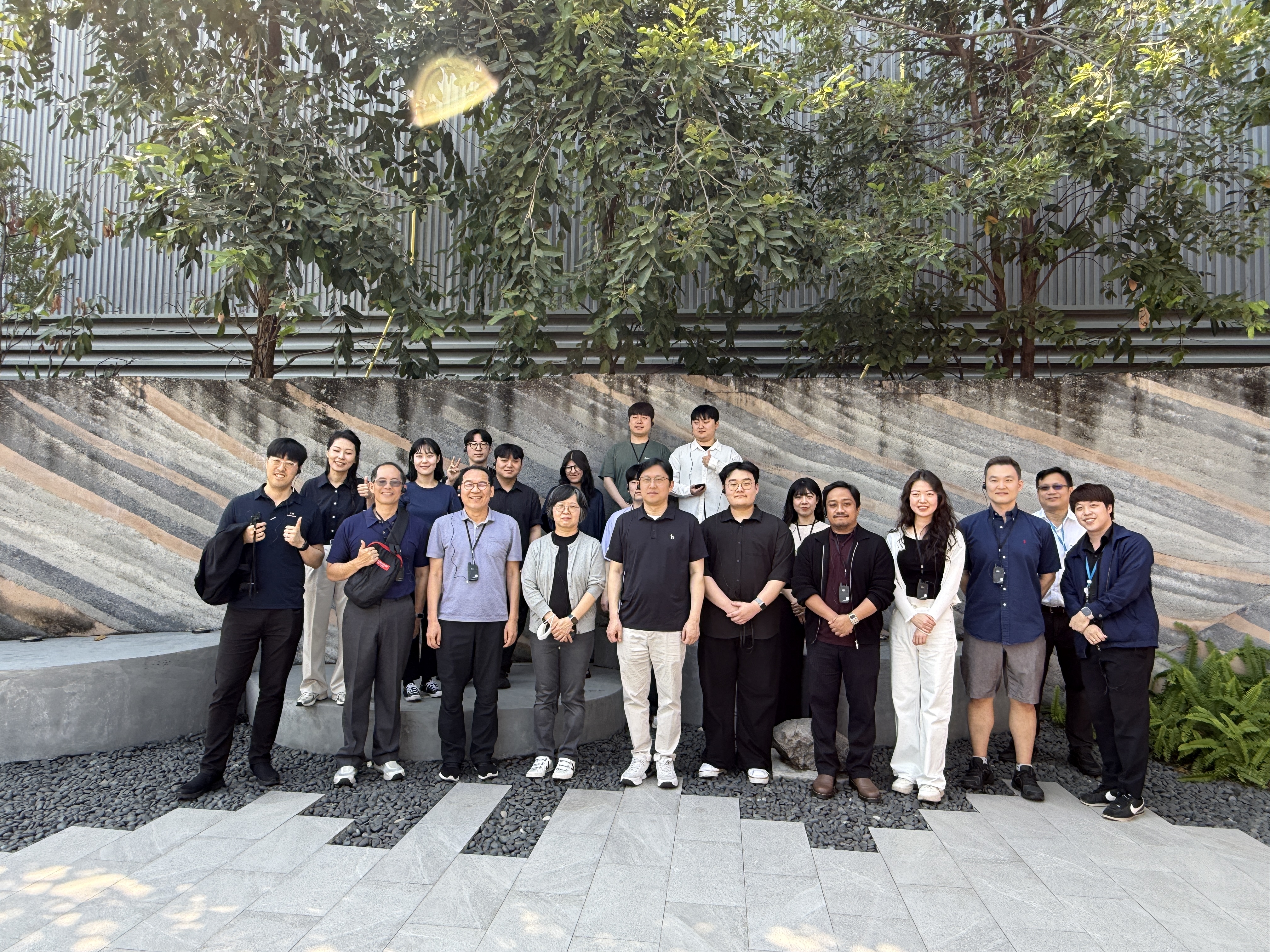
About forty researchers from Korea and Thailand met in Bangkok for three days of CCUS exchange — a full day of research presentations at Chulalongkorn University, a lab tour at PTTEP's Subsurface Research Center, and a student research network session to close things out.
Carbon capture, utilization and storage is a problem neither country solves alone. Korea has been building CCS capability against a hard national emissions target with very limited domestic storage; Thailand sits on depleted gas fields and an operator, PTTEP, already moving on offshore CO₂ storage. The two research agendas complement each other almost too neatly to ignore — which is exactly why this workshop was organized.
The three days were structured around a simple idea: put both research groups in the same room, let everyone present what they are actually working on, and then go look at the facilities where that work gets done.
Organized by
Prof. Hyundon Shin
Department of Energy Resources Engineering,
Inha University
Prof. Kreangkrai Maneeintr
Department of Mining and Petroleum Engineering,
Chulalongkorn University
Who was in the room
~20
Korean participants
- Inha University
- Korea Energy Economics Institute (KEEI)
- Kongju National University
- Other partner institutes
~20
Thai participants
- Chulalongkorn University
- Chiang Mai University
- PTTEP
A deliberately balanced group — roughly forty people in total, split evenly between the two countries, and mixing university researchers, a national energy policy institute, and an operating E&P company. That mix mattered: the same storage question sounds different depending on whether you are simulating it, regulating it, or drilling it.
Day 1 — Research presentations
Held at the Engineering Building, Chulalongkorn University. The day opened with both labs introducing themselves, then ran nine research presentations across two sessions before closing on an open discussion about what to work on together next.
Day 2 — PTTEP Subsurface Research Center
🛢️ Inside an operator's subsurface facility
The second day was given over entirely to PTTEP's Subsurface Research Center (PSRC) — a morning bus ride out of Bangkok, a full lab tour, and the ride back. For the students in particular this was the part that is hard to replicate in a classroom: the core storage, the analytical instruments, and the data infrastructure that an operating company actually runs its subsurface decisions on.
Seeing how core, log, and seismic data are curated and turned into decisions at an E&P company is a useful corrective for anyone who spends most of their time on the simulation side of the same problem. Our own work on digital rock physics and AI-driven subsurface modeling starts from data that someone, somewhere, had to acquire and organize like this.
Day 3 — Chula labs & the student research network
The final morning stayed on campus: a visit to the Petroleum Laboratory at Chulalongkorn University, followed by a student research network session — the part of the program with no fixed script, where graduate students from both countries compared what they are working on directly, without a podium in between.
What we took home
Complementary storage problems
Korea's storage capacity constraint and Thailand's depleted-reservoir opportunity frame the same CCUS question from opposite ends.
Data meets simulation
An operator's subsurface data center is where our modeling assumptions either hold up or do not. Worth seeing in person.
A standing channel
Two labs that now know each other's ongoing work, with a student network underneath it rather than only a faculty handshake.
Thank you to Prof. Kreangkrai Maneeintr and the Chulalongkorn team for hosting, and to PTTEP for opening their Subsurface Research Center to us. Korea and Thailand are working the same CCUS problem from different sides of it — we are looking forward to the next one. 🇹🇭 🤝 🇰🇷